Family and Children
We safeguard the best interests of children and the rights of families
Book a consultation today to discuss your needs and goals.
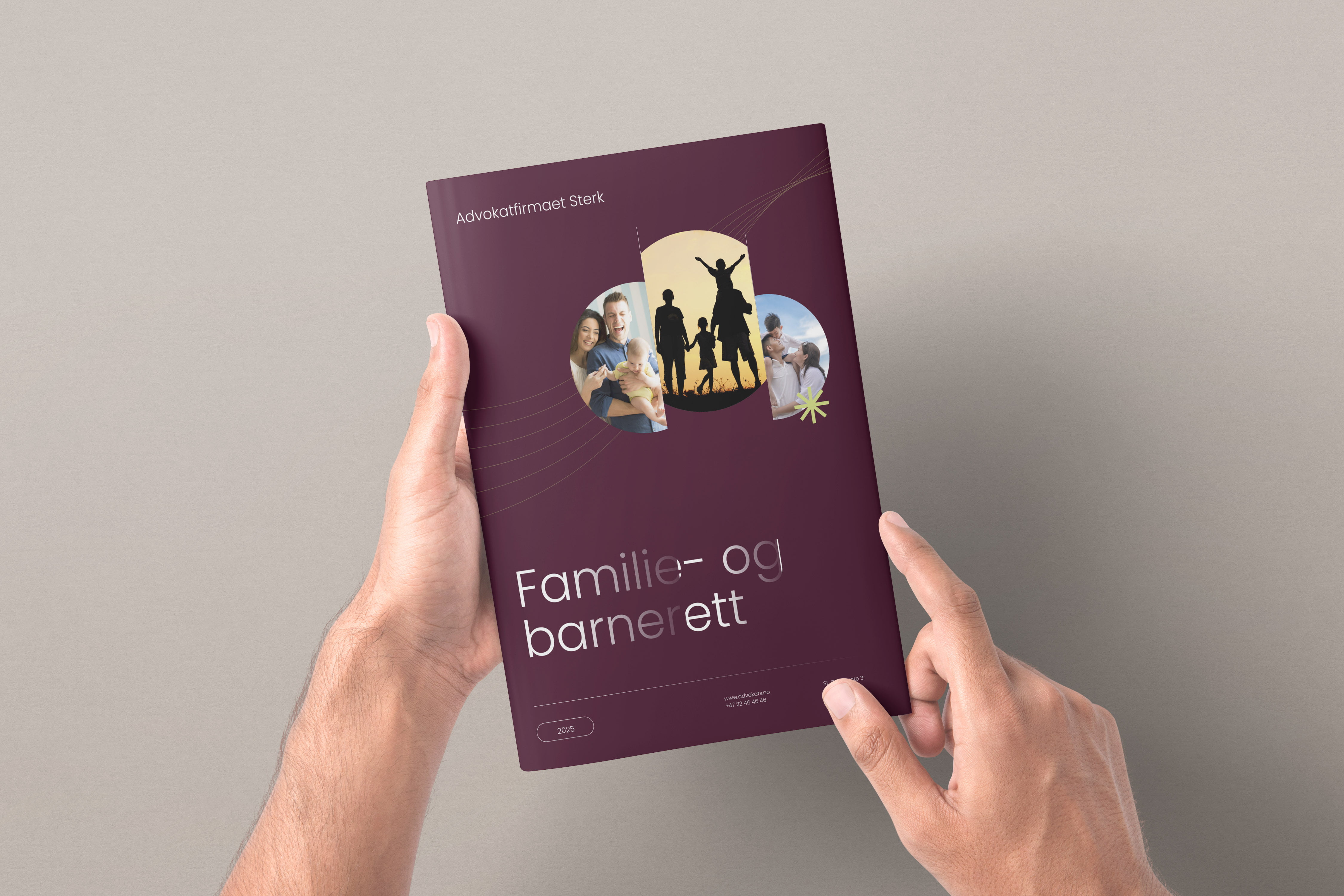
Sterk Law Firm
Reliable and Experienced Assistance in Family and Child Law
Reliable and Experienced Assistance in Family and Child Law
Reliable and Experienced Assistance in Family and Child Law
Family and child law are areas of law that directly affect private life. They may involve the formation or dissolution of marriages, economic relations between spouses and cohabitants, the allocation of parental responsibility, or child welfare cases. Common to all these situations is that they are very personal and can be challenging to handle alone. At Sterk Law Firm, you will receive the support of a dedicated lawyer who thoroughly examines your situation. We listen to your wishes and needs, offering clear guidance on how you should proceed. Our goal is always to arrive at amicable solutions whenever possible, especially in cases involving children. If the matter escalates, we are ready to protect your interests.
Family and child law are areas of law that directly affect private life. They may involve the formation or dissolution of marriages, economic relations between spouses and cohabitants, the allocation of parental responsibility, or child welfare cases. Common to all these situations is that they are very personal and can be challenging to handle alone. At Sterk Law Firm, you will receive the support of a dedicated lawyer who thoroughly examines your situation. We listen to your wishes and needs, offering clear guidance on how you should proceed. Our goal is always to arrive at amicable solutions whenever possible, especially in cases involving children. If the matter escalates, we are ready to protect your interests.
Quick Links

We safeguard the best interests of children and the rights of families
Services
We safeguard the best interests of children and the rights of families
We safeguard the best interests of children and the rights of families
We safeguard the best interests of children and the rights of families
Sterk Law Firm offers a broad range of legal services related to family law, child law, and inheritance law. Our focus is to find effective solutions that protect your rights while always prioritising the best interests of the children. Whether you need assistance in entering into a prenuptial agreement, going through a divorce or resolving a parental dispute, we are ready with solid expertise and extensive experience.
Sterk Law Firm offers a broad range of legal services related to family law, child law, and inheritance law. Our focus is to find effective solutions that protect your rights while always prioritising the best interests of the children. Whether you need assistance in entering into a prenuptial agreement, going through a divorce or resolving a parental dispute, we are ready with solid expertise and extensive experience.
Contact us
Contact Sterk Law Firm for legal assistance and advice. Our dedicated team of experienced lawyers is ready to find tailored solutions for your specific challenges.

Family and Children
Articles

Apr 7, 2025
Contact rights after care takeover – legal frameworks and the best interest of the child
When child welfare services assume custody of a child, important questions arise regarding contact between the child and the parents. Visitation rights represent a complex legal area that balances the child's right to protection against the inviolability of family ties. This article explores the legal foundation for visitation rights, rooted in both Norwegian child welfare law and international human rights conventions. We examine how visitation is determined concretely in each case, without standard norms, and how the goal of reunification influences the extent of visitation. The article also highlights when visitation can be significantly limited or denied, the conditions for supervision during visitation, and the right to contact with siblings and other close relatives. Through rulings from the Supreme Court and the European Court of Human Rights, Norwegian practice has undergone significant changes in recent years—from template-based solutions to individualized assessments that better address the situation and needs of each individual child.

Apr 7, 2025
Care Takeover – Conditions, Implementation, and Rights under the Child Welfare Act.
When child welfare services assume custody of a child, it represents both an intervention in family life and a protection of the child's right to care. This article explores the legal conditions for the assumption of custody, what happens to the responsibility for the child, and when the child may move back home. From the requirement that "the situation must be relatively clearly unsustainable" to the goal of reunification with the family – here you gain insight into the legal framework designed to ensure the child's best interest in some of life's most challenging situations.

Apr 7, 2025
Emergency Measures in Child Welfare – Custody Transfers and Interim Decisions
When children find themselves in situations that require immediate protection, child welfare authorities have several emergency measures at their disposal. The article reviews the four main types of emergency measures: immediate assistance when children lack care, emergency care orders when there is a risk of significant harm to the child, temporary relocation prohibition when moving may harm the child, and emergency placement in institutions for severe behavioral problems or human trafficking. Each measure has different conditions, decision-making authority, and duration. They represent a balance between the need for swift intervention and the consideration of legal rights, and their use has significantly decreased in recent years. In 2021, 694 children were placed in emergency care outside the home, most often due to parental substance abuse, mental illness, or suspicion of violence.

Apr 7, 2025
Assistance Measures in Child Welfare – Voluntary and Mandatory Measures for Children and Families
Support measures constitute the bulk of child welfare services, accounting for nearly 83 percent of all initiated measures. The article reviews the various types of support measures that child welfare can offer, both voluntary and mandatory. Voluntary support measures at home are implemented when the child, due to their care situation or behaviour, has a particular need for help. These measures can include a range from advice and guidance to financial support and respite care. In special cases, child welfare may also offer voluntary placement outside the home. In the absence of consent, the Child Welfare and Health Committee can impose support measures, including care-altering measures, daycare services, and control measures. Child welfare also has the authority to ensure necessary medical treatment and education for children with special needs, as well as to provide follow-up for youths over the age of 18.
Load more
Help
Frequently Asked Questions
1
What does "the best interests of the child" mean?
The best interest of the child is a fundamental principle underlying all decisions concerning children. A specific assessment must be made to determine what is best for each individual child.
1
What does "the best interests of the child" mean?
The best interest of the child is a fundamental principle underlying all decisions concerning children. A specific assessment must be made to determine what is best for each individual child.
1
What does "the best interests of the child" mean?
The best interest of the child is a fundamental principle underlying all decisions concerning children. A specific assessment must be made to determine what is best for each individual child.
2
What is a guardian?
A guardian is a person who is appointed to safeguard personal and/or financial interests for a minor or someone who has been deprived of legal capacity, cf. Guardianship Act chapters 2 and 3.
2
What is a guardian?
A guardian is a person who is appointed to safeguard personal and/or financial interests for a minor or someone who has been deprived of legal capacity, cf. Guardianship Act chapters 2 and 3.
2
What is a guardian?
A guardian is a person who is appointed to safeguard personal and/or financial interests for a minor or someone who has been deprived of legal capacity, cf. Guardianship Act chapters 2 and 3.
3
What is the difference between parental responsibility and visitation rights?
Parental responsibility involves making decisions for the child in personal matters, cf. Section 30 of the Children Act. Visitation rights apply to the parent with whom the child does not live permanently, cf. Section 42 of the Children Act.
4
What is the difference between separation and divorce?
Separation is a condition for divorce and must last for at least 1 year. Most legal effects are similar to those of divorce, except for the right to enter into a new marriage.
4
What is the difference between separation and divorce?
Separation is a condition for divorce and must last for at least 1 year. Most legal effects are similar to those of divorce, except for the right to enter into a new marriage.
4
What is the difference between separation and divorce?
Separation is a condition for divorce and must last for at least 1 year. Most legal effects are similar to those of divorce, except for the right to enter into a new marriage.
5
What is a mediation certificate?
A mediation certificate is proof that parents with children under the age of 16 have completed mandatory mediation upon separation. The certificate is issued by an approved mediator.
5
What is a mediation certificate?
A mediation certificate is proof that parents with children under the age of 16 have completed mandatory mediation upon separation. The certificate is issued by an approved mediator.
5
What is a mediation certificate?
A mediation certificate is proof that parents with children under the age of 16 have completed mandatory mediation upon separation. The certificate is issued by an approved mediator.
6
What is unequal distribution?
Unequal distribution means that one spouse retains more of their assets in a divorce if it would be clearly unreasonable to split evenly, cf. Marriage Act § 59. The assets must come from before the marriage or be inherited/gifted.
6
What is unequal distribution?
Unequal distribution means that one spouse retains more of their assets in a divorce if it would be clearly unreasonable to split evenly, cf. Marriage Act § 59. The assets must come from before the marriage or be inherited/gifted.
6
What is unequal distribution?
Unequal distribution means that one spouse retains more of their assets in a divorce if it would be clearly unreasonable to split evenly, cf. Marriage Act § 59. The assets must come from before the marriage or be inherited/gifted.
7
What is uskifte?
Undivided possession of the estate (uskifte) means that a surviving spouse or partner with common children can take over the estate undivided and postpone the inheritance settlement, cf. the Inheritance Act (arveloven) chapter III. Children from a previous relationship (særkullsbarn) must consent in such cases. What is the difference between separate property and joint property? Joint property is property that the spouses own together and that is divided equally upon divorce. Separate property is excluded from the division. Separate property must be agreed upon in a prenuptial agreement, cf. the Marriage Act (ekteskapsloven) chapter 9.
8
How much is the normal child support?
The amount of the contribution is calculated according to the child support regulations. The main rule is that each parent should pay their share of the maintenance cost based on income.
8
How much is the normal child support?
The amount of the contribution is calculated according to the child support regulations. The main rule is that each parent should pay their share of the maintenance cost based on income.
8
How much is the normal child support?
The amount of the contribution is calculated according to the child support regulations. The main rule is that each parent should pay their share of the maintenance cost based on income.
9
Can children decide where they want to live permanently?
Children have the right to be heard and to participate in decisions that affect them, cf. Children's Act §§ 31-33. The child's opinion should be given weight according to age and maturity. Children over 12 years are to be given considerable weight.

Do you need help?
Contact us for assistance tailored to your specific needs.
Do you need help?
Contact us for assistance tailored to your specific needs.
Explore
Find out how Sterk Law Firm can address your legal needs and assist you in achieving your goals.