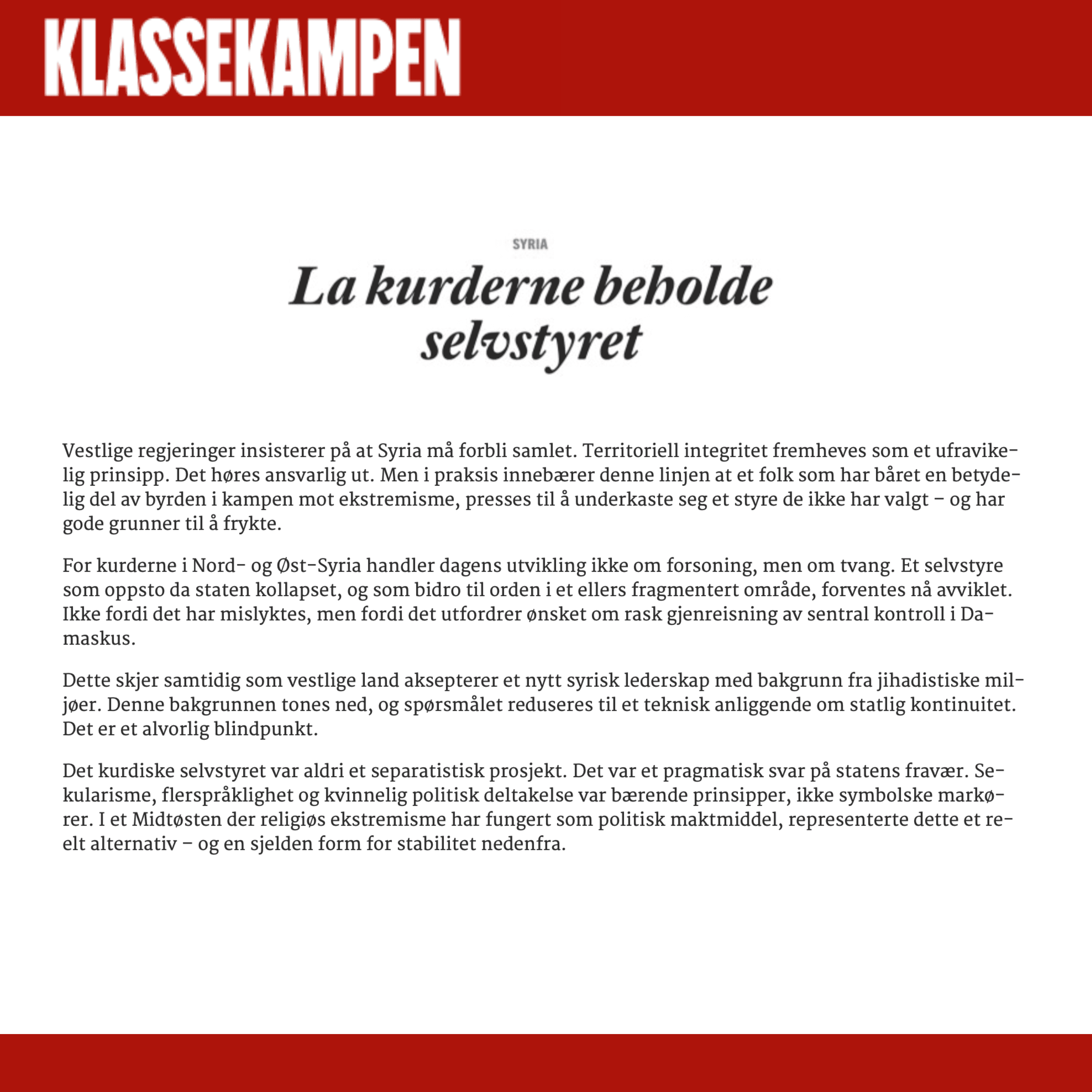
Attorney Servet Yildiz Stêrk has had his op-ed 'Let the Kurds keep their self-government' published in Klassekampen, in which he analyses Western states' Syria policy and the legal and political consequences of dismantling functioning Kurdish self-government in North and East Syria.
The op-ed questions the Western assumption that territorial integrity and the rapid restoration of central state power necessarily bring stability. The experience from Syria suggests rather that, in practice, this approach may mean that a people who have borne a significant share of the burden in the fight against extremism are pressured into submitting to a government they have neither chosen nor have reason to trust.
The Kurdish self-government in North and East Syria is presented not as a separatist project, but as a pragmatic response to the collapse of the state. Arrangements based on secularism, multilingualism and broad political participation – including the representation of women – have contributed to local stability in an otherwise fragmented region. These structures were also decisive in the fight against ISIS, where Kurdish forces served as ground forces for the international coalition and suffered the heaviest losses.
The op-ed further points out that historical experience in the region shows that conditional and reversible minority rights rarely bring lasting stability. Iraq is cited as an obvious corrective: institutionalised Kurdish self-government within the framework of the state has, over time, helped make Iraqi Kurdistan one of the country's most stable regions. This is an empirical argument against the notion that stability requires full central control.
As regards Norway, the op-ed stresses that although its room for manoeuvre is limited, responsibility follows when Norway – together with other Western countries – helps to lend political legitimacy to the authorities in Damascus. Stability cannot be imposed from above, but must be anchored in concrete, verifiable guarantees of political participation, power-sharing and genuine minority protection. In practice, this means working to ensure that existing, functioning self-government arrangements are continued – not dismantled.
The op-ed thus highlights a fundamental problem with state formations and borders rooted in the colonial era: when the formal unity of the state is consistently given priority over the expressed will of the people and their right to self-determination, both stability and the legitimacy the state claims to secure are undermined.